















Shaving with a safety razor – How to use your safety razor correctly
Shaving with a Safety Razor – How to Use Your Safety Razor Correctly
Safety razors – also known as double-edge razors – have been used for many years and are finally making a comeback! To get the most out of them, we've put together a step-by-step shaving guide, as well as other important and helpful tips on shaving with a safety razor. First, you should know that shaving with a safety razor is always a wet shave. If you're still unsure whether wet or dry shaving is better for you, check this out.

Safety Razor Application – How to Get a Good Shave
Are you using a safety razor for the first time, or not getting the desired shaving results yet? We'll explain step-by-step how to shave with a safety razor and give you the best tips. Especially with a safety razor, the correct angle and direction of the stroke are particularly important.
Step 1: Wash your face
Okay, this isn't directly related to shaving itself, but it's part of your routine. So: wash your face with lukewarm water and, if you have oily, normal, or combination skin, also use a gentle scrub. This can help prevent ingrown hairs or razor burn .

Use warm water
Warm water or a towel soaked in very warm water will better prepare your skin and beard for shaving. It opens the pores and simultaneously promotes blood circulation. That's why we also recommend shaving right after showering. The water shouldn't be too hot, as it can dry out your skin.
If your beard hairs are longer than 5-6 mm, it makes sense to trim your beard beforehand. This will give you the best shaving result.
Step 2: Apply shaving cream or oil
Here you are spoiled for choice: shaving soap, foam, oil or cream. Lather a few pumps in your hands and apply generously to your face and beard. It's especially elegant and effective to lather shaving soap with a shaving brush in a shaving bowl. Massage the lather thoroughly in circular motions so that it reaches your skin.

Step 3: Hold the safety razor at a 30-degree angle
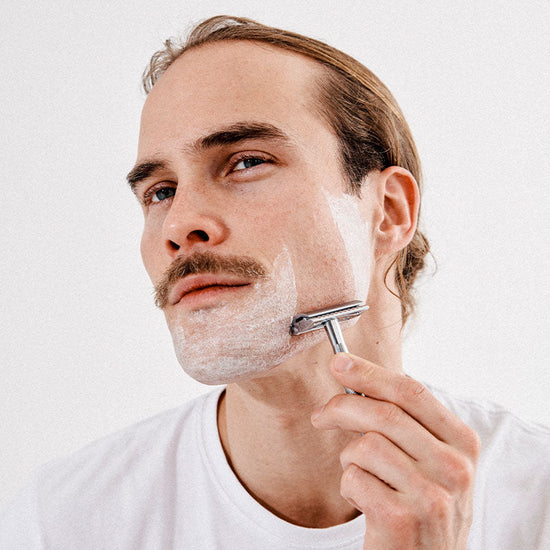
Your safety razor should be at approximately a 30-degree angle to your skin. Then, shave in short strokes, first in the direction of hair growth, trying not to go over the same area more than 2-3 times. This helps prevent razor burn and is much gentler on the skin. While shaving, it greatly helps your blade if you pull the skin to be shaved taut with your fingers and apply only light pressure. If you are not satisfied with the shaving result in some areas, you can also shave across or against the direction of hair growth.

Important!
Don't forget to remove hairs from your blades, especially with a longer beard. Simply hold your safety razor under running water or use an old toothbrush. Even with a closed comb, you should never touch the blade with your fingers, as it is extremely sharp.
Step 4: Post-shave care (h3)
Finished? Great. Then first wash off all product residues and stubble with cold water and pat your skin dry with a fresh towel. Shaving is always stressful for your skin. To do something good for it and prevent razor burn, post-shave care is really important. A high-quality aftershave spray or aftershave balm provides moisture and has an antibacterial effect.

For daily use..
For daily use, we recommend a beard oil or a beard and face cream. For longer beard hairs, a beard brush can also be useful. A good beard care routine is already half the battle for a great shaving result.
Step 5: Cleaning the safety razor
Your safety razor can last you a lifetime. To ensure this, thoroughly rinse your safety razor after each use, removing hair, foam residue, and skin particles. You can unscrew the razor head and carefully remove the blade by holding the short, blunt sides. Then, pat it dry and store it in a dry place.

How often should I change my safety razor blade?
Unfortunately, there is no "one size fits all" solution for this. How often you need to change your blade depends on how well you care for it, how robust or thick your beard hair is, and whether you only shave contours or your entire face. If you notice during shaving that the blade no longer cuts cleanly or even tugs, it's time to replace it. You can also turn the blade over and shave with the unused side. Depending on these factors, you should change the blade after 3–12 shaves.
Note: If you use the safety razor for other body parts, please change the blade before a new shave to prevent germs from reaching your face.

Safety razor vs. cartridge razor: Are safety razors really better?
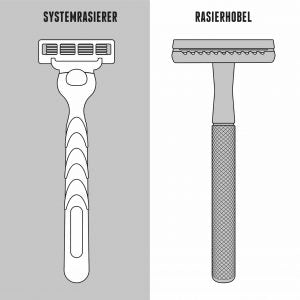
The main difference between the two razors lies in blade sharpness and the number of blades.
While a cartridge razor has two to six staggered blades in a plastic head, a safety razor uses just one.

Are multiple blades supposed to provide a smoother result, and is that true?
We recommend not shaving over the same area more than 2–3 times with a safety razor. However, with a five-blade cartridge razor, you shave over the same area 5 times in one stroke. This not only shaves the hair but also removes the top layer of skin. This can quickly lead to inflammation and the unpopular razor burn. Additionally, it's difficult to clean between the blades of your cartridge razor, allowing bacteria to easily accumulate. These bacteria can then get onto your skin during the next shave, worsening any inflammation. The blade of a safety razor is much sharper and doesn't dull as quickly as those in cartridge razors, which is why going over the same area 1–2, or at most 3 times, is often sufficient.
So far, the safety razor is clearly the better choice, and it's also much more sustainable. Why, then, do cartridge razors exist? They are slightly easier to use. The blades are already positioned at a 30-degree angle, so all you have to do is shave. That's it.
Safety razor: open comb vs. closed comb
Closed comb means that the blade protrudes only a few millimeters, minimizing the risk of injury. The smooth comb can glide gently over your skin. With an open comb, the gap between the comb and the blade is larger, making it suitable for very thick, wiry, or curly beard growth. The blade can capture these hairs better but irritates the skin more than a closed comb, and the risk of injury is greater.

Never used a safety razor before?
If you've never used a safety razor and are new to it, a closed comb is the better and safer choice. There are also safety razors with adjustable combs, where the blade gap can be adjusted as desired.
How do I insert and change razor blades?
 |
 |
 |
|
Step 1: You can detach the head of the safety razor from the handle by twisting it. Carefully remove the old blade and store it in a container. |
Step 2: Take a new razor blade from the packaging. Important: Hold it either from the top and bottom or by the short, blunt sides. The blade is very sharp, and you can easily cut yourself. Insert the blade into the razor head. |
Step 3 : Now you can screw the handle back onto the head and begin shaving. |
FAQ
Is a safety razor better for the skin?
Yes, your skin much prefers being shaved by a safety razor! It's less irritated, and the top layer of skin remains intact. Nevertheless, you should not neglect your pre- and aftershave routine.
Which safety razor is the best?
The one from Brooklyn Soap, of course! 😉 This question cannot be answered generally. First, consider whether you prefer an open or closed comb. This decision will already rule out some models. Then, visually, you can choose between a wooden or metal handle and classic silver or, for example, rose gold. There are many models from different manufacturers. It's worth not choosing the cheapest one and opting for quality. However, you don't have to spend a lot of money to get a high-quality safety razor . Ours, for example, costs only €29.95, is in the mid-range, has top barbershop quality, and lasts a lifetime.
How do I dispose of the blades?
An old jam jar or a tin can are suitable for this. You can store the used blades there and then take them to collection points or a recycling center, where they can be recycled. Since these collection points differ in each federal state, inquire in your federal state where you can best dispose of your blades. If this is not an option for you, unfortunately, like other used hygiene products, they belong in the residual waste.
Action: With every order at Brooklyn Soap, you receive one of our limited edition razor blade boxes for free with the code CLEANSHAVE! The tins are perfect for storing new or used razor blades.
Can a safety razor be used by women, men, and non-binary people?
Yes, the safety razor is not reserved only for men or beard shaving. Legs, armpits, back, stomach, intimate area, and all possible hairy areas can be shaved with a safety razor. Here too, skin and hair should be prepared, and especially in the intimate area, particular caution is advised for beginners.
Armpits should be shaved in every direction, as the hair does not grow as uniformly as beard or leg hair, for example. If you use your safety razor for multiple areas, try to change the blades in between and clean the safety razor very thoroughly to give germs no chance.
Sharing is Caring!
Do you have tips for shaving with a safety razor or any unanswered questions? We look forward to hearing from you on Instagram and Facebook .
Discover more shaving care tips in our Academy

Read more

Dandruff in the Beard – How to Recognize and Get Rid of It Dandruff is completely normal and often goes unnoticed. Your skin renews its...

Tattoo Care After Getting Inked How to properly care for your new tattoo Have you just gotten a new tattoo, or are you planning to? Ni...